SSH Propagation Payload Analysis
While monitoring my AWS Cowrie honeypot, I observed repeated SSH sessions that uploaded a file named sshd. What initially appeared to be several different payloads turned out to be repeated deployments and incomplete transfers of the same 30.3 MB Linux executable.
By correlating Cowrie session logs, SSH fingerprints, file hashes, attacker commands, and static analysis of the captured binary, I was able to reconstruct a larger pattern of automated SSH activity.
Repeated Payload Deployment
The complete payload was captured with the following SHA-256 hash:
94f2e4d8d4436874785cd14e6e6d403507b8750852f7f2040352069a75da4c00
Cowrie recorded the complete payload being uploaded from seven different source IP addresses between September 17 and October 3, 2026.
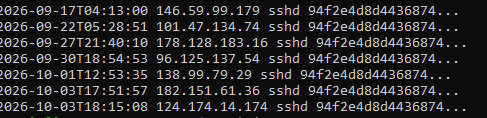
The successful deployments followed a consistent pattern:
- Authenticate to SSH using a weak root credential
- Upload a file named
sshdusing SFTP - Make the file executable with
chmod +x - Launch it in the background using
nohup - Disconnect
Most successful sessions authenticated using:
root / ubuntu
The final observed deployment used:
root / debian
The first two deployments launched the binary without additional arguments. Beginning September 27, later sessions supplied roughly 50 IP addresses as command-line arguments:
chmod +x ./<directory>/sshd;
nohup ./<directory>/sshd <IP1> <IP2> <IP3> ... &
Several IP addresses appeared repeatedly between these target lists. Two addresses that had previously uploaded the payload to my honeypot later appeared as arguments in another deployment.
This suggests the IP lists may have been used for automated targeting or propagation, although the command-line arguments alone do not prove that every listed system was successfully attacked.
SSH Fingerprint Correlation
I compared the SSH clients responsible for the payload deployments.
All seven complete-payload sessions advertised:
SSH-2.0-Go
They also shared the same HASSH fingerprint:
98ddc5604ef6a1006a2b49a58759fbe6
Searching the complete Cowrie dataset revealed 27 sessions using this fingerprint.
Several of those additional sessions also attempted to upload sshd, while others performed different activity. Because a HASSH fingerprint represents an SSH client's key-exchange configuration, it cannot identify an attacker by itself.
However, the combination of the same SSH fingerprint, Go client, filename, credentials, payload, and deployment commands provides much stronger evidence of related automated activity.
Static Payload Analysis
I analyzed the captured binary without executing it.
The complete sample was:
- 30,304,472 bytes
- ELF 64-bit x86-64 executable
- Dynamically linked
- Stripped
- Built with substantial Go components
Static analysis revealed SSH and authentication-related functionality including:
github.com/pkg/sftpgithub.com/msteinert/pam- PTY support
- SSH host-key paths
- Go networking and cryptography packages
Application-specific strings included:
main.credential
[]main.credential
attackqueue
sharepeer
shareupdateinfo
These strings suggest the program maintains credentials and an attack queue and contains functionality for communicating or sharing information between instances.
The binary also contains references to multiple services used to determine a system's public IP address, including ipify, ipinfo, ident.me, and AWS CheckIP.
A hardcoded Discord webhook was also present. The webhook token was intentionally omitted from this repository and was never contacted or tested.
Persistence Indicators
Static strings also revealed what appears to be a systemd persistence mechanism:
/bin/systemd-worker
/lib/systemd/system/systemd-worker.service
ExecStart=/bin/systemd-worker
WantedBy=multi-user.target
Environment="HOME=/"
The binary also contains unusually high process and file-descriptor limits associated with the service.
These strings strongly suggest the program contains functionality for installing itself as a service named systemd-worker.
Because this conclusion comes from static analysis, it does not prove that the persistence mechanism was executed during the observed honeypot sessions.
Incomplete Payload Captures
Several other sessions using the same SSH fingerprint uploaded files named sshd with different SHA-256 hashes.
At first, these appeared to be separate payload variants.
Their sizes ranged from only 65,536 bytes to nearly the complete 30.3 MB binary. Several smaller samples still contained the same distinctive strings found in the complete payload.
I tested whether these files were actually incomplete copies of the full payload by comparing every captured byte against the complete sample.
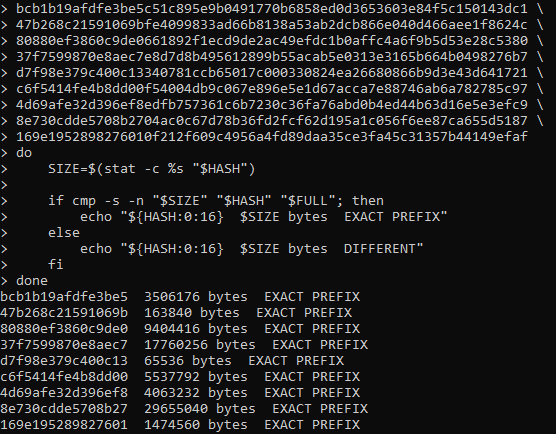
Every smaller sample was an exact byte-for-byte prefix of the complete payload.
| Capture | Size | Result |
|---|---|---|
bcb1b19... |
3,506,176 B | Exact prefix |
47b268c... |
163,840 B | Exact prefix |
80880ef... |
9,404,416 B | Exact prefix |
37f7599... |
17,760,256 B | Exact prefix |
d7f98e3... |
65,536 B | Exact prefix |
c6f5414... |
5,537,792 B | Exact prefix |
4d69afe... |
4,063,232 B | Exact prefix |
8e730cd... |
29,655,040 B | Exact prefix |
169e195... |
1,474,560 B | Exact prefix |
This indicates that these were truncated transfers of the same binary, not separate malware variants.
It also explains why some partial files were still recognized as ELF executables while reporting missing section headers: the ELF header and beginning of the program had transferred successfully, but the upload ended before the complete file arrived.
This was also a useful reminder that hashes must be interpreted in context. Interrupted transfers of the same payload produce completely different SHA-256 hashes.
Assessment
The evidence indicates that I captured a recurring automated SSH operation deploying the same Linux payload over approximately 17 days.
The strongest correlation points were:
- Identical complete payload SHA-256
- Repeated
sshdfilename - Same
SSH-2.0-Goclient - Same HASSH fingerprint
- Similar weak root credentials
- Consistent SFTP → chmod → nohup deployment
- Repeated IP lists supplied to later executions
- Multiple incomplete transfers confirmed as exact prefixes of the full payload
Static analysis indicates that the payload contains SSH, PAM authentication, SFTP, credential handling, attack-queue, networking, and possible persistence functionality.
Together, the evidence is consistent with an SSH-focused malicious program capable of automated credential attacks and/or propagation.
I have intentionally not assigned the sample to a specific malware family or threat actor because the evidence collected from the honeypot is not sufficient for confident attribution.
Honeypot Safety
The payload was captured by Cowrie and was never executed on the actual EC2 host.
Commands entered by attackers were handled inside Cowrie's emulated environment, allowing the sessions and uploaded files to be studied without intentionally running the captured malware.
All analysis performed for this project was static.